
Volume 1: Sustainability Appraisal of the Maidstone Gypsy, Traveller and Travelling Showpeople Development Plan Document 2023–2040
1.1 Purpose of this report
1.1.1 Lepus Consulting Ltd (Lepus) has been instructed by Maidstone Borough Council (MBC) to undertake a Sustainability Appraisal (SA) process, incorporating the requirements of Strategic Environmental Assessment (SEA), for the Maidstone Gypsy, Traveller and Travelling Showpeople Development Plan Document (GTTS DPD).
1.1.2 The purpose of SA is to assess the extent to which a plan or programme will help to achieve environmental, economic, and social sustainability.
1.1.3 The GTTS DPD is being prepared by MBC to address the accommodation needs of the Gypsy, Traveller and Travelling Showpeople (GTTS) communities within the borough. The DPD will form a statutory component part of the local development framework, alongside other plan documents including the Local Plan and various neighbourhood plans.
1.1.4 MBC are currently at the 'Preferred Policies and Potential Sites' (Regulation 18c) stage of plan making, which is the third consultation stage in the DPD process so far, with the first being 'Scoping, Issues and Options' (Regulation 18a) in 2023 and the second 'Preferred Approaches' (Regulation 18b) in 2024.
1.1.5 This Regulation 18c SA Report has been prepared as the third stage of the SA process for the DPD, following on from the Regulation 18b SA Report (September 2024), whereby reasonable alternative policy approaches were evaluated, and the SA Scoping Report (June 2023), which identified the scope and level of detail to be included in the SA process.
1.1.6 This Regulation 18c SA Report presents assessments of reasonable alternative sites considered during the plan preparation, alongside the assessments of the revised draft policies and site allocation policies as set out in MBC's GTTS Regulation 18c 'Preferred Policies and Potential Sites' Consultation document. The reasonable alternative sites were assessed first and helped to inform MBC's preliminary selection of sites for allocation, as set out in the site policies.
1.1.7 This report will be published for consultation with the statutory consultation bodies, as required by Regulation 12 (5) of The Environmental Assessment of Plan and Programmes Regulations 20041 (SEA Regulations), and will also be made available for wider public consultation alongside the Regulation 18c 'Preferred Policies and Potential Sites' version of the DPD.
1.2 Maidstone Borough
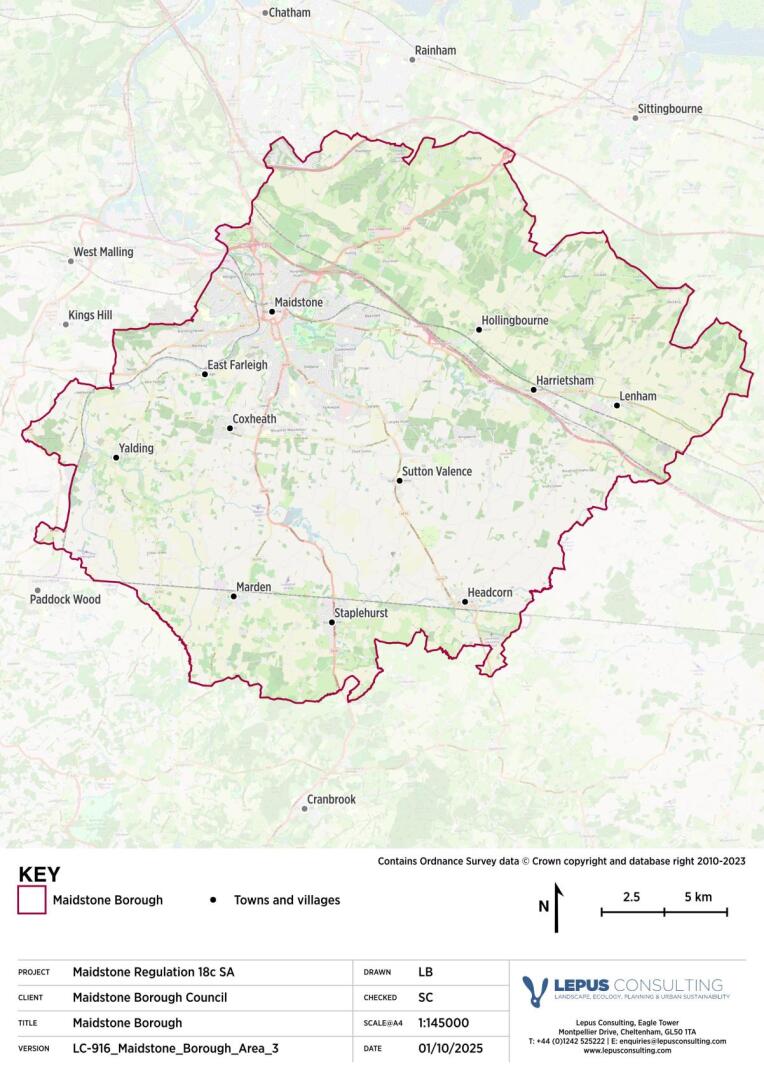
1.2.1 Maidstone Borough comprises roughly 39,300ha, with a population of 175,800 people according to the 2021 Census2. Figure 1.1 shows Maidstone's administrative boundary, which comprises the Plan area for the GTTS DPD.
1.2.2 Maidstone Borough is located between the Channel Tunnel and London, connected by the M20 and M2 motorways and three central railway stations to London, Ashford, Medway and Tonbridge.
1.2.3 The key strategic centre of the borough is Maidstone, the County Town of Kent. Maidstone town is home to one of the largest retail centres in the south east of England and plays a role in the visitor economy due to being home to the likes of Maidstone Museum, the Hazlitt Theatre and Maidstone United Football Club grounds at the Gallagher Stadium.
1.2.4 Maidstone is home to a prosperous employment base, with 75.8% of residents being economically active3. However, due to its relatively low wage economy there is often out- commuting to higher paying areas.
1.2.5 Maidstone Borough encompasses a small section of the Metropolitan Green Belt to the west of the borough, with 27% of the borough forming part of the Kent Downs National Landscape. The borough benefits from various built and natural assets including 45 conservation areas, over 2,000 listed buildings, and 26 scheduled monuments (SMs), alongside 15 registered parks and gardens (RPGs) that are noted as being of special historic interest. The borough is accompanied by areas of ancient woodland (7%), 11 Sites of Special Scientific Interest (SSSIs), three local nature reserves, the North Downs Woodlands Special Area of Conservation (SAC), and 34 verges of nature conservation interest.
1.2.6 The River Medway flows through both the borough and town centre, with its tributaries, including the Rivers Beult and Teise, found in the east and south of the borough. The Medway Valley is the largest catchment in the borough and is also the largest in Kent.
1.2.7 Maidstone Borough has a rich history of GTTS communities. According to recent Census data, Maidstone has the highest proportion of GTTS across the country making up 0.6% of the population, constituting 1.4% of the total Gypsy or Irish Traveller population in England and Wales4. The GTTS DPD highlights the large GTTS population present within the area and subsequently draws out the importance of planning and provisioning for the c.576 GTTS households within the borough.
1.3 Requirement for the Gypsy, Traveller and Travelling Showpeople DPD
1.3.1 The Maidstone Local Plan Review (LPR) 2021-20385 was adopted in March 2024. The LPR sets out the policies and plans to guide future development in the borough to 2038.
1.3.2 Within chapter seven of the LPR, Policy LPRSP10(C) 'Gypsy and Traveller site allocations' sets out the need for new pitches. At the time of submission of the LPR, the Gypsy, Traveller and Travelling Showpeople Accommodation Assessment (GTAA) had not been completed but it was estimated that there would be significant need to meet the demand for pitches in the Maidstone area, including approximately 543 pitches for Gypsies and Travellers and seven plots for Travelling Showpeople over the period 2023 to 2040. As such, the need to progress undertaking a separate GTTS DPD was identified which would seek to ensure the needs of the community are met and sufficient sites for pitches/plots could be identified. The requirement to prepare the DPD is set out in Policy LPRSP10(C) as replicated in Box 1.1.
1.3.3 Policy LPRSP10(C) of the adopted LPR sets out sites carried over from the previous Local Plan (2017) where these allocations had not yet been fully delivered.
Box 1.1: Adopted LPR Policy LPRSP10(C) 'Gypsy and Traveller Site Allocations'
|
LPR Policy LPRSP10(C) 'Gypsy and Traveller Site Allocations'
|
|---|
|
1.3.4 Chapter nine of the LPR sets out the Council's aim to ensure accommodation needs for Gypsies and Travellers are met. Policy LPRHOU8 'Gypsy, Traveller and Travelling Showpeople Accommodation' details the criteria against which planning applications for GTTS use in Maidstone will be determined, with the subsequent aim to "contribute towards the creation of sustainable communities by making an appropriate scale of pitch provision". The full policy is set out in Box 1.2.
Box 1.2: Adopted LPR Policy LPRHOU8 'Gypsy, Traveller and Travelling Showpeople Accommodation'
| LPR Policy LPRHOU8 'Gypsy, Traveller and Travelling Showpeople Accommodation' |
|---|
|
1.3.5 The GTTS DPD is therefore being prepared, in accordance with national and local planning policy, to:
- identify accommodation needs for GTTS communities from 2023 to 2040;
- set out the spatial strategy and identify sites and broad locations for growth to meet accommodation needs;
- include strategic thematic policies and detailed development management policies; and
- review LPR policies LPRSP10(C) and LPRHOU8 (see Boxes 1.1 and 1.2) as well as the LPR detailed site allocation policies LPRGT1(1) – LPRGT1(11).
1.4 Determining the GTTS accommodation needs in Maidstone
Gypsy, Traveller and Travelling Showpeople Accommodation Assessment
1.4.1 MBC commissioned a Gypsy, Traveller and Travelling Showpeople Accommodation Assessment (GTAA), the latest iteration of which was published in April 20258. This assessment sought to provide an understanding of current and future accommodation needs of GTTS in the Maidstone Borough area for the period 2023-2040.
1.4.2 In accordance with Planning Policy for Traveller Sites (PPTS)9:
- Gypsies and Travellers are defined as “persons of nomadic habit of life whatever their race or origin, including such persons who on grounds only of their own or their family’s or dependants’ educational or health needs or old age have ceased to travel temporarily or permanently, and all other persons with a cultural tradition of nomadism or of living in a caravan, but excluding members of an organised group of travelling showpeople or circus people travelling together as such”; and
- Travelling Showpeople are defined as “members of a group organised for the purposes of holding fairs, circuses or shows (whether or not travelling together as such). This includes such persons who on the grounds of their own or their family’s or dependants’ more localised pattern of trading, educational or health needs or old age have ceased to travel temporarily or permanently, but excludes Gypsies and Travellers as defined above”.
1.4.3 The GTAA identifies the need for new sites within Maidstone Borough, but also highlights the likelihood that a proportion of the accommodation need could be met through the intensification, expansion and natural turnover of existing sites, rather than solely through the need for pitches on additional sites.
1.4.4 Taking into account the latest changes to national PPTS (meaning that households who have ceased to travel permanently now fall under the planning definition), the GTAA reported a need for 407 pitches for Gypsy and Traveller households that met the planning definition, and 122 pitches for undetermined households (i.e., households where it was not possible to confirm their status but are likely to meet the PTTS definition). Furthermore, a need for four plots for Travelling Showpeople households that met the planning definition, and three plots for undetermined households, was identified.
1.4.5 Therefore, the current overall requirements for the DPD over the Plan period are 529 pitches for Gypsies and Travellers and seven plots for Travelling Showpeople.
Pitch Deliverability Assessment
1.4.6 The Council has commissioned a Pitch Deliverability Assessment (PDA) to identify the need and ability for the delivery of GTTS pitches/plots in Maidstone, including the potential for intensification and expansion on existing sites (see Chapter 9 of the GTAA10). The identified potential uplift in pitches at each site has been used to inform the SA process, including the assessment of sites and policies in determining the ability of MBC to meet their identified GTTS need.
1.4.7 Findings from the initial PDA work suggest that up to 82% of the full identified accommodation needs could theoretically be met within existing sites. However, this level of deliverability may be tempered by factors affecting site achievability i.e. ability to accommodate further pitches through a policy-complaint scheme; as well as by the feedback from this consultation.
1.5 Best practice guidance
1.5.1 Government policy recommends that both SA and SEA are undertaken under a single SA process, which incorporates the requirements of the SEA Regulations. This can be achieved through integrating the requirements of SEA into the SA process. The approach for carrying out an integrated SA and SEA is based on best practice guidance:
- European Commission (2004) Implementation of Directive 2001/42 on the assessment of the effects of certain plan and programmes on the environment11.
- Office of Deputy Prime Minister (2005) A Practical Guide to the SEA Directive12.
- Ministry of Housing, Communities & Local Government (MHCLG) (2024) National Planning Policy Framework (NPPF)13.
- Department for Levelling Up, Housing and Communities (DLUHC) and MHCLG (2024) Planning Practice Guidance (PPG)14.
- Royal Town Planning Institute (RTPI) (2018) Strategic Environmental Assessment, Improving the effectiveness and efficiency of SEA/SA for land use plans15.
1.6 National Gypsy and Traveller Policy
1.6.1 The requirement to assess the accommodation needs of Gypsies and Travellers and Travelling Showpeople is established through national guidance contained in PPTS (2024)16. This is made clear in paragraph 4 of the NPPF (2024).
1.6.2 A summary of the government's aims for traveller sites has been reproduced from the PPTS as follows (paragraph 4):
- That local planning authorities should make their own assessment of need for the purposes of planning;
- To ensure that local planning authorities, working collaboratively, develop fair and effective strategies to meet need through the identification of land for sites;
- To encourage local planning authorities to plan for sites over a reasonable timescale;
- That plan-making and decision-taking should protect Green Belt from inappropriate development;
- To promote more private traveller site provision while recognising that there will always be those travellers who cannot provide their own sites;
- That plan-making and decision-taking should aim to reduce the number of unauthorised developments and encampments and make enforcement more effective;
- For local planning authorities to ensure that their Local Plan includes fair, realistic and inclusive policies;
- To increase the number of traveller sites in appropriate locations with planning permission, to address under provision and maintain an appropriate level of supply;
- To reduce tensions between settled and traveller communities in plan-making and planning decisions;
- To enable provision of suitable accommodation from which travellers can access education, health, welfare and employment infrastructure; and
- For local planning authorities to have due regard to the protection of local amenity and local environment.
1.7 Integrated approach to SA and SEA
1.7.1 The requirements to carry out SA and SEA are distinct, although it is possible to satisfy both obligations using a single appraisal process. PPG on SEA and SA17 states: “Sustainability appraisals incorporate the requirements of the Environmental Assessment of Plans and Programmes Regulations 2004 (commonly referred to as the ‘Strategic Environmental Assessment Regulations’). Sustainability appraisal ensures that potential environmental effects are given full consideration alongside social and economic issues”.
1.7.2 The SEA Directive applies to a wide range of public plans and programmes, including land use plans (see Article 3(2)) of the SEA Directive18). The Directive has been transposed into English law by the Environmental Assessment of Plans and Programmes Regulations 2004 (the SEA Regulations, SI no. 163319).
1.7.3 SEA is a systematic process for evaluating the environmental consequences of proposed plans or programmes to ensure environmental issues are fully integrated and addressed at the earliest appropriate stage of decision-making. The SEA Directive and SEA Regulations require an environmental report in which the likely significant effects on the environment are identified for local plan proposals and reasonable alternatives.
1.7.4 SA is a UK-specific procedure used to appraise the impacts and effects of development plans in the UK. It is required by S19 (5) of the Planning and Compulsory Purchase Act 2004 and should be an appraisal of the economic, social and environmental sustainability of development plans. The present statutory requirement for SA lies in The Town and Country Planning (Local Planning) (England) Regulations 2012.
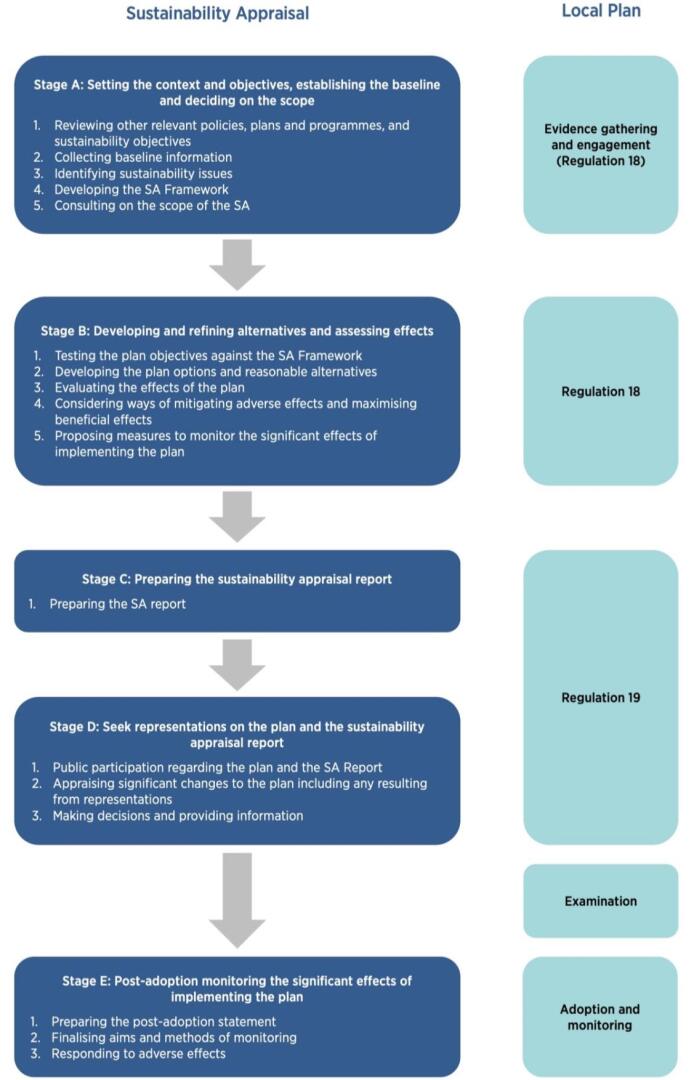
1.7.5 This document is a component of the SA of the MBC GTTS DPD. It provides an assessment of the likely effects of reasonable alternatives, as per Stage B of Figure 1.2, according to PPG on SA20.
1.8 The SA process so far
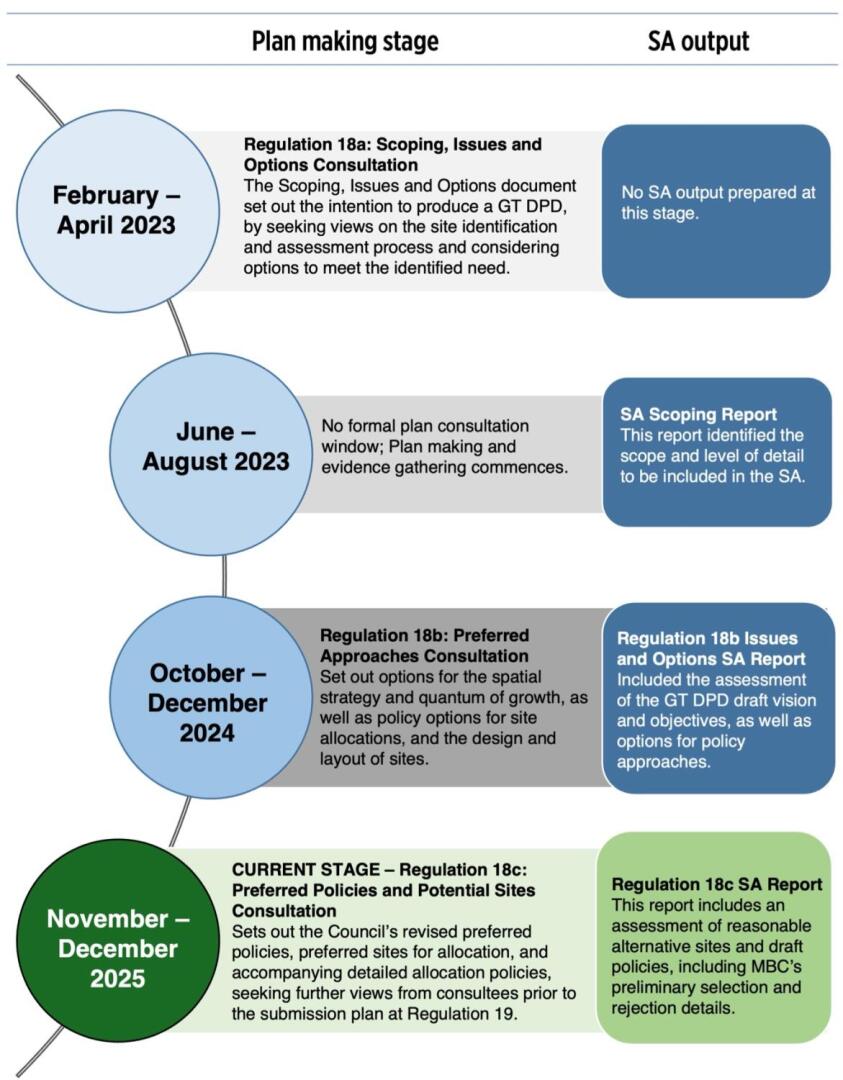
1.8.1 Figure 1.3 provides a timeline of stages of the DPD and SA process so far. To date, this represents Stages A and B of the SA process as shown in Figure 1.2.
1.8.2 So far, MBC have held two public consultations to help shape the emerging GTTS DPD:
- Regulation 18a 'Scoping, issues and options' consultation (February 2023)21 which sought to inform statutory consultees, the public and relevant organisations of MBC's intention to produce a DPD. Views were sought on site identification and assessment processes including options to meet the GTTS accommodation need throughout the borough; and
- Regulation 18b 'Preferred approaches' consultation (October 2024)22 which set out the direction of travel and sought views on the spatial strategy, as well as preferred and indicative policies. No sites were identified at this stage.
1.8.3 The current stage of plan making is known as Regulation 18c 'Preferred policies and potential sites' whereby MBC is seeking feedback on their emerging preferred approach for the DPD policies and site allocations that have been identified drawing on earlier consultation feedback and outputs of the iterative SA process.
Scoping
1.8.4 The SA Scoping Report, produced by Lepus in 2023, sought to identify the level of detail and relevant information which should be included in the SA process. The Scoping Report represented Stage A of the SA process (see Figure 1.2) and set out information relating to:
- Identifying other relevant plans, programmes and environmental protection objectives;
- Collecting baseline information;
- Identifying sustainability problems and any key issues;
- Preparing the SA Framework; and
- Consultation arrangements on the scope of SA with the consultation bodies.
1.8.5 The Scoping Report was consulted on between 29th June and 3rd August 2023 with the statutory bodies Natural England, Historic England and the Environment Agency. Comments received during the consultation were used to prepare an updated version of the SA Scoping Report23, and have been considered in the subsequent SA stages. Table 1.1 provides a summary of the responses received and how these comments have been incorporated into the SA process.
Table 1.1: Consultation responses from statutory consultees on SA Scoping Report (August 2023)
|
Consultee |
Summary / extract of consultation response |
Incorporation into the SA |
|
Natural England |
“Natural England has no specific comments to make on this SA / SEA scoping report for the emerging Maidstone Gypsy, Travellers and Travelling Show-people Development Plan.” |
N/A |
|
Historic England |
“…We are content that the scoping report for Maidstone Gypsy Travellers and Travelling Showpeople DPD adequately covers the issues that may arise in respect of the potential effects of proposed development sites on heritage assets.” |
N/A |
|
Environment Agency |
|
Sewerage and wastewater drainage has been considered in the assessments under SA Objective 7: Water including within the assessment of draft DPD policies (Appendix D). Potential effects on groundwater SPZs have been considered in the evaluation of reasonable alternative sites within SA Objective 7: Water, presented in Appendix C. Potential effects on SSSIs, including the River Beult, have been considered in the evaluation of reasonable alternative sites within SA Objective 11: Biodiversity, presented in Appendix C. Recommendations are presented in Chapter 8 of this report, including those taking into account the Environment Agency's comments. |
Regulation 18b: Preferred Approaches
1.8.6 The Regulation 18b Preferred Approaches SA Report24 was produced by Lepus in September 2024 and provided an evaluation of reasonable alternatives identified by MBC to inform the identification of the preferred approach, as set out in Stage B of the SA process (see Figure 1.2).
1.8.7 The SA Report included an assessment of reasonable alternatives, or 'options', set out in the Preferred Approaches document prepared by MBC. These related to options for growth and the spatial strategy, and other policy areas.
1.8.8 The Regulation 18b Preferred Approaches SA Report was published for consultation between 31st October and 12th December 2024 with statutory consultees, other stakeholders and the general public, with respondents invited to provide comments on the SA in MBC's questionnaire. Comments received during the Regulation 18b consultation were analysed by MBC, identifying that many of these were not specific comments in regard to the SA, but were instead site-specific comments or general comments regarding the wider principle of the DPD. Those comments received which were relevant for the SA are summarised in Table 1.2 alongside an explanation as to how these have been considered during the preparation of this Regulation 18c SA Report.
Table 1.2: Consultation responses from statutory consultees on SA Regulation 18b Report (September2024)
|
Consultee |
Summary / extract of consultation response |
Incorporation in to the SA |
|
Natural England |
No specific comments on the R18b SA. |
N/A |
|
Historic England |
No specific comments on the R18b SA. |
N/A |
|
Environment Agency |
No specific comments on the R18b SA. |
N/A |
|
Kent County Council |
“The County Council, as Lead Local Flood Authority, supports the recommendation within paragraph 3.2.7 to provide additional wording within the DPD to further enhance green and blue infrastructure”. “…the County Council recommends applying the Sequential Test. Any new development should be directed to Flood Zone 1 in the first instance (areas with a low probability of river or sea flooding). Where there are no reasonably available sites in Flood Zone 1, then the flood risk vulnerability of land uses should be taken into account and consideration given to reasonably available sites in Flood Zone 2 (areas with a medium probability of river or sea flooding), applying the Exception Test if required. Only where there are no reasonably available sites in Flood Zones 1 or 2 should the suitability of sites within Flood Zone 3 (areas with a high probability of river or sea flooding) be considered, taking into account the flood risk vulnerability of land uses and applying the Exception Test if required. The County Council stresses that, regardless of Flood Zone, the sequential approach to the layout of the proposals should always be followed.” |
The SA includes evaluation of reasonable alternative sites using the latest available flood risk evidence from the Environment Agency (see Appendix C). Recommendations have been made throughout the SA, including in relation to the site allocation policies (Appendix F) in terms of ensuring that the Sequential Test is applied and the Exception Test is used where necessary. If/when available, the outputs of these processes will be incorporated into the SA. See also the summary of recommendations in Chapter 8. |
|
Anonymous |
“…The Sustainability Appraisal fails to provide a balanced, evidence-based evaluation of the proposed Traveller site developments. It neglects key social, economic, and environmental risks, offering only superficial mitigation measures that lack enforceability or specificity. For the appraisal to be credible and acceptable to the local community, it must:
Without these critical changes, the SA remains fundamentally flawed and cannot be relied upon to guide sustainable or equitable development in the borough”. |
The SA strives to balance social, economic and environmental aspects of sustainability including the requirement of the DPD to meet accommodation needs for the GTTS communities as far as possible. It is important to note that the SA is a strategic-level tool focused on evaluating the relative sustainability of policies and reasonable alternatives, rather than providing detailed implementation or management plans. For example, it is beyond the scope of the SA to predict or quantify potential impacts on crime levels or local property values. Mitigation measures are set out in Appendix E, based on available information at this stage of plan-making. These will be revisited and, where appropriate, refined in more detail at the Regulation 19 stage, including the approach to monitoring. |
|
Anonymous |
“Although it is clearly important to deliver housing needs for traveller individuals, when focusing on high density sites with many of these individuals catered for in small proximity, this causes vast problems with their own community and also to neighbours and villages of that area”. |
Recommendations are presented in Chapter 8 of this report, including those highlighting the challenges of high-density development. |
|
Anonymous |
“I feel like the focus of the report is the sustainability of the standards of the local environmental 'expected' by the settled community, rather than the sustainability of the livelihoods of a minority community in our area?”. |
The SA Framework (see Appendix A) includes objectives that cover impacts on the travelling community, as well as potential impacts on social, economic and environmental receptors as a result of the proposed GTTS development. |
|
Anonymous |
“This is a very rose tinted vision of what the future could be. The strategy is contradictory to the local plan, especially in the area I live, on the one hand sustainability is a key to developments in the area but this strategy seems to lean towards expanding already over crowded, due to being illegally expanded already, poorly managed and maintained G&T sites with the only sustainability accessed via a treacherous main road with no path or lighting. The area also has numerous illegal sites situated in close proximity which can possibly become labelled windfall sites if applied for, regardless of again the sustainability and the impact of the Site on the settled community. There are much more suitable areas that accommodate the G&T requirements where there is access safely to amenities and allows integration into a wider community with many more options for the young G&T population. It appears to me that the easier and cheaper option has been pushed forward rather than something that may positively impact all communities”. |
Comments noted. The DPD seeks to plan for the identified accommodation needs for GTTS communities in a sustainable way, with consideration of reasonable alternatives explored via the SA process. All reasonable alternative development sites for GTTS use have been identified by MBC. Any further reasonable alternatives that are identified can be evaluated in the next iteration of the SA. |
|
Anonymous |
“I believe the objectives on page 14 should apply to all sites including windfall. I would also like to comment that in the SA framework it only states how sites will impact on the travelling community i.e. air/ noise pollution, access to local services etc. I believe this should state how it will also affect the settled community with regards to things like air/noise pollution, access to local services etc.”. | The SA Framework (see Appendix A) includes objectives that cover impacts on the travelling community, as well as potential impacts on social, economic and environmental receptors as a result of the proposed GTTS development. |
|
Anonymous |
“The chosen spatial approach does not reflect the settlement hierarchy or the locations that are most sustainable within the Borough. There is not enough detailed work here on why the two most sustainable locations have simply been dismissed. Why is Invicta Barracks not considered preferential? Detail and evidence are lacking in this regard and it should not move forward on this basis without more information being submitted in this regard”. |
All reasonable alternative development sites for GTTS use have been identified by MBC. Any further reasonable alternatives that are identified can be evaluated in the next iteration of the SA. |
1.9 Signposting for this report
1.9.1 The contents of this SA Report, including the appendices which provide essential contextual information to the main body of the report, are listed below:
1.9.2 Volume 1: Main Regulation 18c SA Report (this document):- Chapter 1 (this chapter) sets out the purpose, context and introduction to the GTTS DPD and the accompanying SA process.
- Chapter 2 sets out the assessment methodology and scope of the appraisal.
- Chapter 3 summarises the assessment of the 158 reasonable alternative sites, pre-mitigation.
- Chapter 4 summarises the assessment of the nine over-arching DPD policies.
- Chapter 5 summarises the assessment of the 158 reasonable alternative sites, post-mitigation.
- Chapter 6 presents MBC's preliminary reasons for selection and rejection of each reasonable alternative site.
- Chapter 7 summarises the assessment of the 27 site allocation policies.
- Chapter 8 sets out a range of recommendations for MBC to consider as they develop the policies and allocations for the emerging DPD.
- Chapter 9 sets out the next steps for the SA.
Volume 2: Appendices:
- Appendix A presents the SA Framework.
- Appendix B sets out the topic-specific methodology and assumptions applied in the evaluation of reasonable alternative sites.
- Appendix C sets out the full evaluation of the 158 reasonable alternative sites against each SA Objective, pre-mitigation.
- Appendix D presents the assessment of the nine over-arching DPD policies.
- Appendix E sets out the post-mitigation assessment of the 158 reasonable alternative sites against each SA Objective.
- Appendix F presents the assessment of DPD site allocation policies for MBC's potential sites at this stage of plan making.
1 Environmental Assessment of Plans and Programmes Regulations (2004). Available at: http://www.legislation.gov.uk/uksi/2004/1633/contents/made [Date accessed: 25/09/25]
2 ONS (2022) How the population changed in Maidstone: Census 2021. Available at: https://www.ons.gov.uk/visualisations/censuspopulationchange/E07000110/ [Date accessed: 25/09/25]
3 ONS (2024) Labour market Profile – Maidstone. Available at: https://www.nomisweb.co.uk/reports/lmp/la/1946157316/report.aspx?town=maidstone [Date accessed: 25/09/25]
4 ONS (2023) Gypsy or Irish Traveller populations, England and Wales: Census 2021. Available at: https://www.ons.gov.uk/peoplepopulationandcommunity/culturalidentity/ethnicity/articles/gypsyoririshtravellerpopulationsenglandan dwales/census2021 [Date accessed: 25/09/25]
5 Maidstone Borough Council (2024) Adopted Local Plan Review 2021-2038. Available at: https://localplan.maidstone.gov.uk/home/local-plan-review [Date accessed: 25/09/25]
6 Caravans Sites and Control of Development Act 1960: https://www.legislation.gov.uk/ukpga/Eliz2/8-9/62
7 Caravans Sites Act 1968: http://www.legislation.gov.uk/ukpga/1968/52/contents
8 ORS (2025) Maidstone Borough Council Gypsy and Traveller Accommodation Assessment (GTAA) Final Report, April 2025. Available at: https://drive.google.com/file/d/18obwgzVDoV5jna3q6UxJFYUgGiQDLQfF/view [Date accessed: 12/08/25]
9 MHCLG (2024) Planning policy for traveller sites. Updated 12 December 2024. Available at: https://www.gov.uk/government/publications/planning-policy-for-traveller-sites/planning-policy-for-traveller-sites [Date accessed: 12/08/25]
10 ORS (2025) Maidstone Borough Council Gypsy and Traveller Accommodation Assessment (GTAA) Final Report, April 2025. Available at: https://drive.google.com/file/d/18obwgzVDoV5jna3q6UxJFYUgGiQDLQfF/view [Date accessed: 12/08/25]
11 European Commission (2004) Implementation of Directive 2001/42 on the assessment of the effects of certain plan and programmes on the environment. Available at: http://ec.europa.eu/environment/archives/eia/pdf/030923_sea_guidance.pdf [Date accessed: 25/09/25]
12 Office of Deputy Prime Minister (2005) A Practical Guide to the SEA Directive. Available at: https://assets.publishing.service.gov.uk/government/uploads/system/uploads/attachment_data/file/7657/practicalguidesea.pdf [Date accessed: 25/09/25]
13 MHCLG (2024) National Planning Policy Framework, December 2024. Available at: https://www.gov.uk/government/publications/national-planning-policy-framework--2 [Date accessed: 25/09/25]
14 DLUHC & MHCLG (2024) Planning practice guidance. Available at: https://www.gov.uk/government/collections/planning- practice-guidance [Date accessed: 25/09/25]
15 RTPI (2018) Strategic Environmental Assessment, Improving the effectiveness and efficiency of SEA/SA for land use plans. Available at: https://www.rtpi.org.uk/research/2018/january/strategic-environmental-assessment-seasa-for-land-use-plans/ [Date accessed: 25/09/25]
16 DLUHC & MHCLG (2024) Planning policy for traveller sites. Available at: https://www.gov.uk/government/publications/planning- policy-for-traveller-sites [Date accessed: 25/09/25]
17 MHCLG (2020) Guidance: Strategic environmental assessment and sustainability appraisal. Available at: https://www.gov.uk/guidance/strategic-environmental-assessment-and-sustainability-appraisal [Date accessed: 25/09/25]
18 Directive 2001/42/EC of the European Parliament of the Council of 27 June 2001 (SEA Directive). Available at: https://eur- lex.europa.eu/legal-content/EN/TXT/?uri=CELEX:32001L0042 [Date accessed: 25/09/25]
19 The Environmental Assessment of Plans and Programmes Regulations (2004). Available at: http://www.legislation.gov.uk/uksi/2004/1633/contents/made [Date accessed: 25/09/25]
20 DLUHC & MHCLG (2020) Guidance: Strategic environmental assessment and sustainability appraisal. Available at: https://www.gov.uk/guidance/strategic-environmental-assessment-and-sustainability-appraisal [Date accessed: 02/06/23]
21 Maidstone Borough Council (2023) GTTS DPD Regulation 18a 'Scoping, issues and options consultation document'. Available at: https://drive.google.com/file/d/1sKOSywFRfoIt8BPd5cNBxP59a78-NAyA/view [Date accessed: 25/09/25]
22 Maidstone Borough Council (2024) GTTS DPD Regulation 18b 'Preferred approaches consultation' Available at: https://drive.google.com/file/d/1nSEOiTbrjCZDTA0dLspqiKgEA1GBd-xn/view [Date accessed: 25/09/25]
23 Lepus Consulting (2023) Sustainability Appraisal of the Maidstone Gypsy, Traveller and Travelling Showpeople Development Plan Document: Scoping Report, August 2023. Available at: https://drive.google.com/file/d/1E8Aam5q2wABO77KDV8UhOsT0vNtU9mNU/view [Date accessed: 25/09/25]
24 Lepus Consulting (2024) Sustainability Appraisal of the Maidstone GTTS DPD: Regulation 18b Preferred Approaches, September 2024. Available at: https://drive.google.com/file/d/1QTdfIgiCSTfp-QI70M9L2PnZVzqQxlHo/view [Date accessed: 25/09/25]
